

When “almost right” is not safe enough
In any environment where ionising radiation is present, measurement is everything.
From nuclear facilities to healthcare and research, radiation protection instruments are relied upon every day often without question. A reading is checked, a threshold is confirmed, and work continues. Quietly, these devices shape decisions that impact both safety and operations.
But what happens when that reading is wrong?
- Not dramatically wrong
- Not obviously broken
- Just slightly off
That is where the real risk lies.
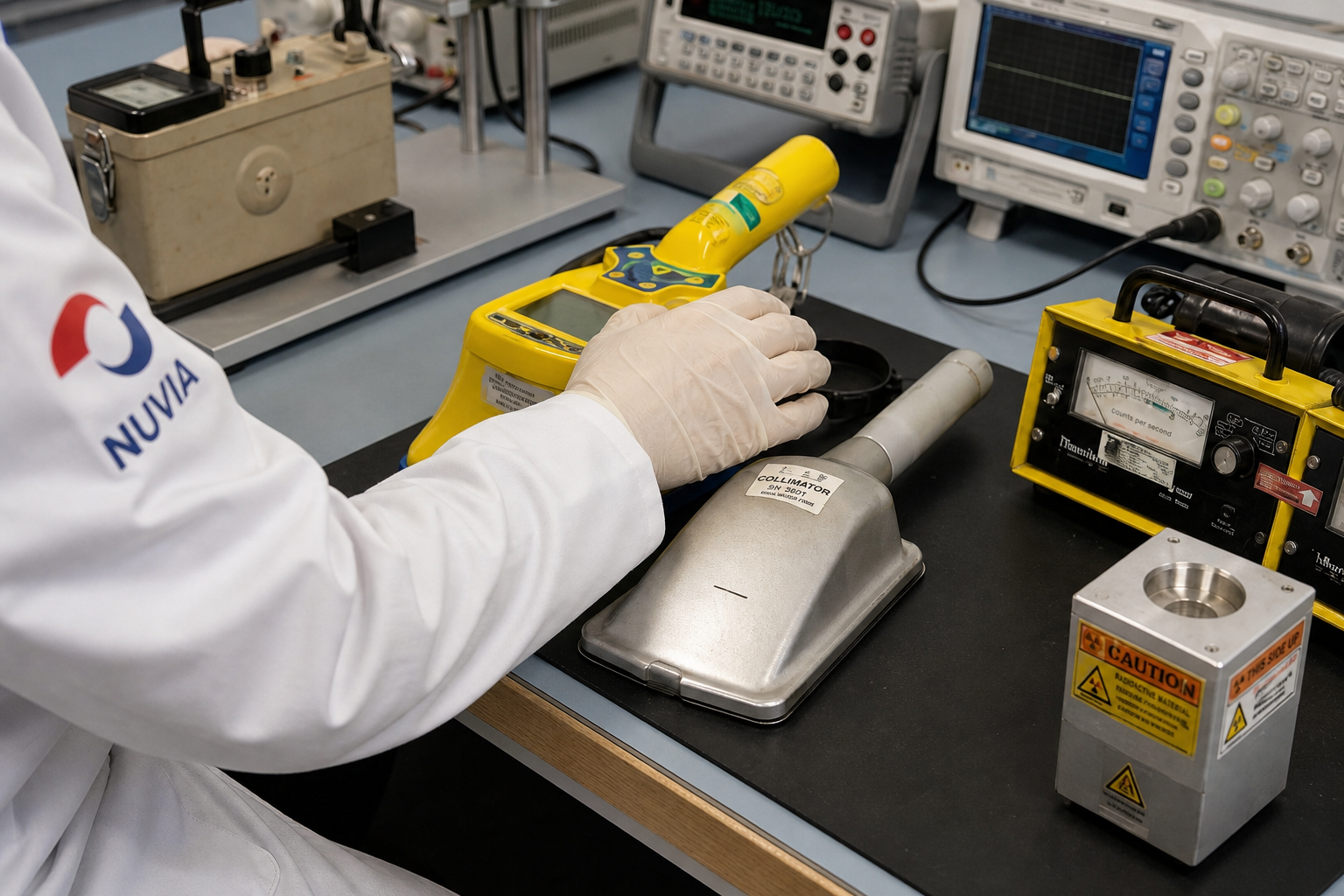
Calibration is often seen as a routine requirement a scheduled task, a certificate to renew, a box to tick. In reality, it is one of the most critical controls in any radiological environment.
In practice, maintaining calibration is not always straightforward particularly on complex sites, where multiple teams share equipment, instruments move between locations, backup devices enter service, and manual tracking systems struggle to keep pace. Over time, calibration dates can lapse and records become fragmented, reducing visibility and control.
Without it, the integrity of the entire protection system begins to weaken.
The Invisible Risk
An uncalibrated instrument rarely fails in an obvious way. It does not stop working it continues to provide readings. The problem is that those readings may no longer reflect reality.
A small deviation can mean:
- Exposure going undetected
- False alarms disrupting operations
- Incorrect assumptions about safety conditions
The consequences of this type of failure are well documented.
In a U.S. radiotherapy incident (1974–1976), a cobalt treatment unit was not properly recalibrated for nearly two years, resulting in more than 400 patients receiving significant overdoses.
In Costa Rica (1996), a misinterpretation during the calibration process led to extended treatment times resulting in overdoses of approximately 66%.
In Panama (2000), the absence of independent verification between calculated and measured dose resulted in patients receiving double the intended radiation dose.
Even outside of the clinical context, the impact can be critical. During the Chernobyl response (1986–1987), dosimetry systems were inconsistent and, in some cases, unreliable, significantly hindering the accurate assessment of worker exposure. In the early stages of the incident, the lack of reliable measurements and high uncertainty in dose rates demonstrated how quickly control can be lost when measurement systems are insufficient or not fully trusted.
These were not cases of lack of knowledge. They were failures in verification, traceability, and system control.
In high‑reliability environments, “almost right” is not safe enough.
A Global Regulatory Expectation
The importance of calibration is reflected clearly in international regulatory frameworks. Organisations such as the IAEA, the UK HSE, and CNEN in Brazil require that radiation protection instruments are calibrated regularly and remain traceable to recognised standards.
Standards such as 10 CFR 20.1501 formalise this requirement, ensuring that measurements used to protect people and environments are demonstrably reliable.
Yet, despite this clarity, audit findings consistently show that calibration failures remain among the most common non‑compliances worldwide.
This disconnect highlights a recurring issue: while the requirement is well understood, the depth and complexity of proper calibration is often underestimated.
What Reliable Calibration Really Means
Calibration is not simply the adjustment of a device. It is a controlled and traceable process that establishes confidence in measurement.
A reliable calibration requires:
- Traceability to national or international standards (e.g. NIST, UKAS)
- Detector‑specific procedures, recognising that different technologies respond differently to radiation fields
- Full documentation, including uncertainties, conditions, and limitations
- Integration with maintenance or repair activities, ensuring performance is validated after intervention
These elements are interdependent. Calibration is not a single activity it is part of a broader measurement assurance system.
More Than Compliance
Ultimately, calibration is not about meeting a requirement. It is about ensuring that every decision based on a measurement is built on something reliable.
Because when a technician checks a reading, there is an implicit assumption:
That the number can be trusted.
That trust is not inherent it is built through process, control, and verification.
In radiological environments, the difference between safe and unsafe is not always visible.
It is only measurable.
